

Wheel Knowledge
Book a ServiceHow is a tyre put together, what do the numbers on the sidewall mean, and how do you keep an eye on tread depth and pressure? Here is what to know about your Volkswagen's wheels and tyres.
Reading a Tyre
Every tyre carries its full specification on the sidewall — a code such as225 / 45 R 17 94 V. It tells you the exact size, and the load and speed the tyre is built for. Fitting a size that isn't listed on your vehicle's tyre placard or Certificate of Conformity can affect handling, the speedometer reading and your cover.
225Section width
Tyre width in millimetres, measured across the widest point of the sidewall.
45Aspect ratio
Sidewall height as a percentage of the section width — here, 45% of 225 mm.
RConstruction
Radial-ply construction — standard on every modern passenger car.
17Rim diameter
Diameter of the wheel the tyre is designed to fit, in inches.
94Load index
The maximum load each tyre may carry — index 94 is roughly 670 kg.
VSpeed rating
The maximum speed the tyre is rated for — a "V" tyre is rated to 240 km/h.
Markings and Construction
Tyre Markings
Beyond the size code, the sidewall carries the brand and model, the DOT code with the four-digit week/year of manufacture, the maximum load and pressure, and often "M+S" or a plus symbol identifying a Volkswagen Genuine +Tyre.
Tyre Label
New tyres carry a standardised label rating fuel efficiency (rolling resistance), wet grip and external rolling noise. It is a quick way to compare two tyres of the same size before you buy.
Rim Markings
A rim is stamped with its width in inches, the diameter, the offset (ET) and the bolt pattern. Genuine Volkswagen rims also carry a part number — the middle group -601- for Genuine rims, -071- for Volkswagen Accessories rims.
All-Terrain Markings
Tyres suited to gravel and light off-road use are marked "M+S" (mud and snow) or "A/T". For Namibian conditions, look for a reinforced casing and a higher load rating rather than a seasonal marking.
Tyre Structure
A tyre is built up in layers: an airtight inner liner, textile body plies, steel belts under the tread for stability, and the bead wire that clamps the tyre to the rim. Damage that reaches the belts or bead cannot be repaired.
Tread Depth and Tyre Pressure
Two quick checks tell you most of what you need to know about a tyre's condition. Both take a minute and both have a real effect on braking, fuel use and safety.
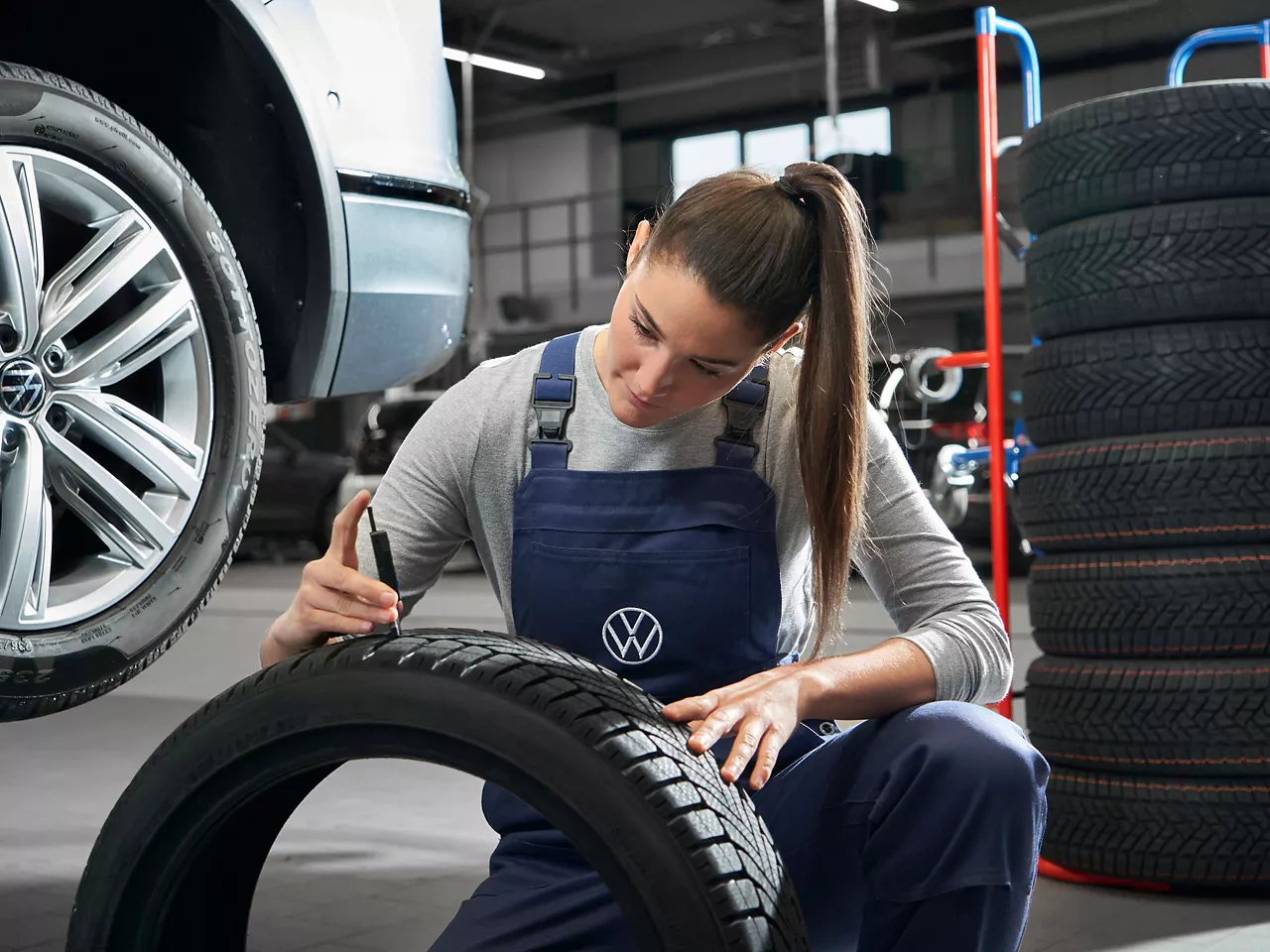
- Tread depth: the legal minimum in Namibia is 1 mm across the full width; we recommend replacing at 3 mm. Below that, wet braking distances grow quickly. Check the raised wear-indicator bars in the tread grooves.
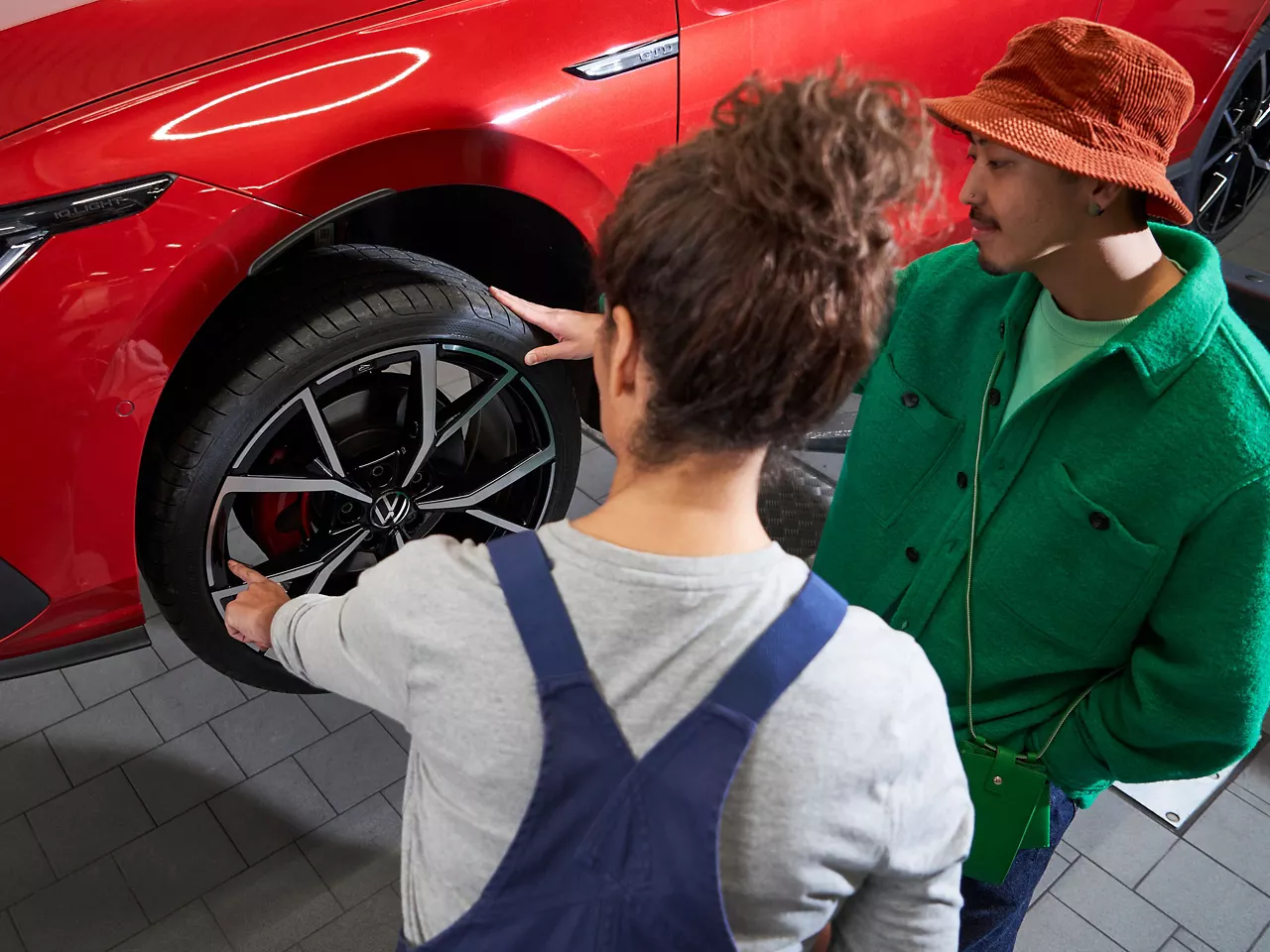
- Tyre pressure: set it to the figure on your car's placard (door pillar or fuel flap), on cold tyres, at least once a month. Use the higher “full load” figure when the car is loaded.
- Uneven wear — more on the shoulders, the centre, or one edge — points to pressure or alignment problems. Have it looked at before it costs you a set of tyres.
Tyres for Namibian Roads
Long distances, high temperatures and plenty of gravel are hard on tyres. Heat raises the running pressure and ages the rubber; gravel cuts and chips the tread and sidewalls. Choose a tyre with a reinforced casing and the right load rating for how you use the car, check pressures when the tyres are cold, and look the tyres over after any long gravel trip. Replace tyres older than about five years even if the tread still looks good.
Wheels and Tyres
FAQ on Wheel Knowledge
Where do I find the correct tyre pressure for my Volkswagen?
The recommended pressures are printed on a placard on the driver's door pillar or inside the fuel-filler flap, and repeated in the owner's manual. Two sets are usually given — one for a lightly loaded car and a higher one for a full load. Use the higher figure whenever you are carrying passengers and luggage or towing.
How often should I check my tyre pressure?
At least once a month and before every long trip. Always check on cold tyres — before driving, or after no more than about two kilometres — because a warm tyre reads higher. Never let air out of a warm tyre to bring it back to the placard figure.
Is it normal for a tyre to lose pressure over time?
A slow loss of around 0.1 bar over a couple of months is normal. Anything faster points to a leaking valve, a puncture, a poor bead seal or a cracked rim — have the wheel checked rather than simply topping it up.
What happens if my tyres are over- or under-inflated?
Under-inflation raises rolling resistance and fuel use, builds up heat that can lead to a blow-out at speed in hot weather, and wears the two shoulders of the tread. Over-inflation reduces grip and ride comfort and wears out the centre of the tread. Both shorten tyre life.
What tread depth do my tyres need?
The legal minimum in Namibia is 1 mm of tread across the full width of the tyre (1.6 mm in South Africa). We recommend replacing tyres at around 3 mm, as wet-weather braking and aquaplaning resistance fall away sharply below that. Use the wear indicators — small raised bars moulded into the bottom of the tread grooves — as your guide.
How do gravel roads and heat affect my tyres?
Gravel causes cuts, chips and sidewall damage and wears tread faster, while high ambient temperatures raise the running pressure and speed up rubber ageing. After longer gravel trips, check the pressures once the tyres have cooled and look over the tread and sidewalls for damage. Tyres more than about five years old should be inspected for fine cracking even if the tread looks fine.
AirStop® Tyres
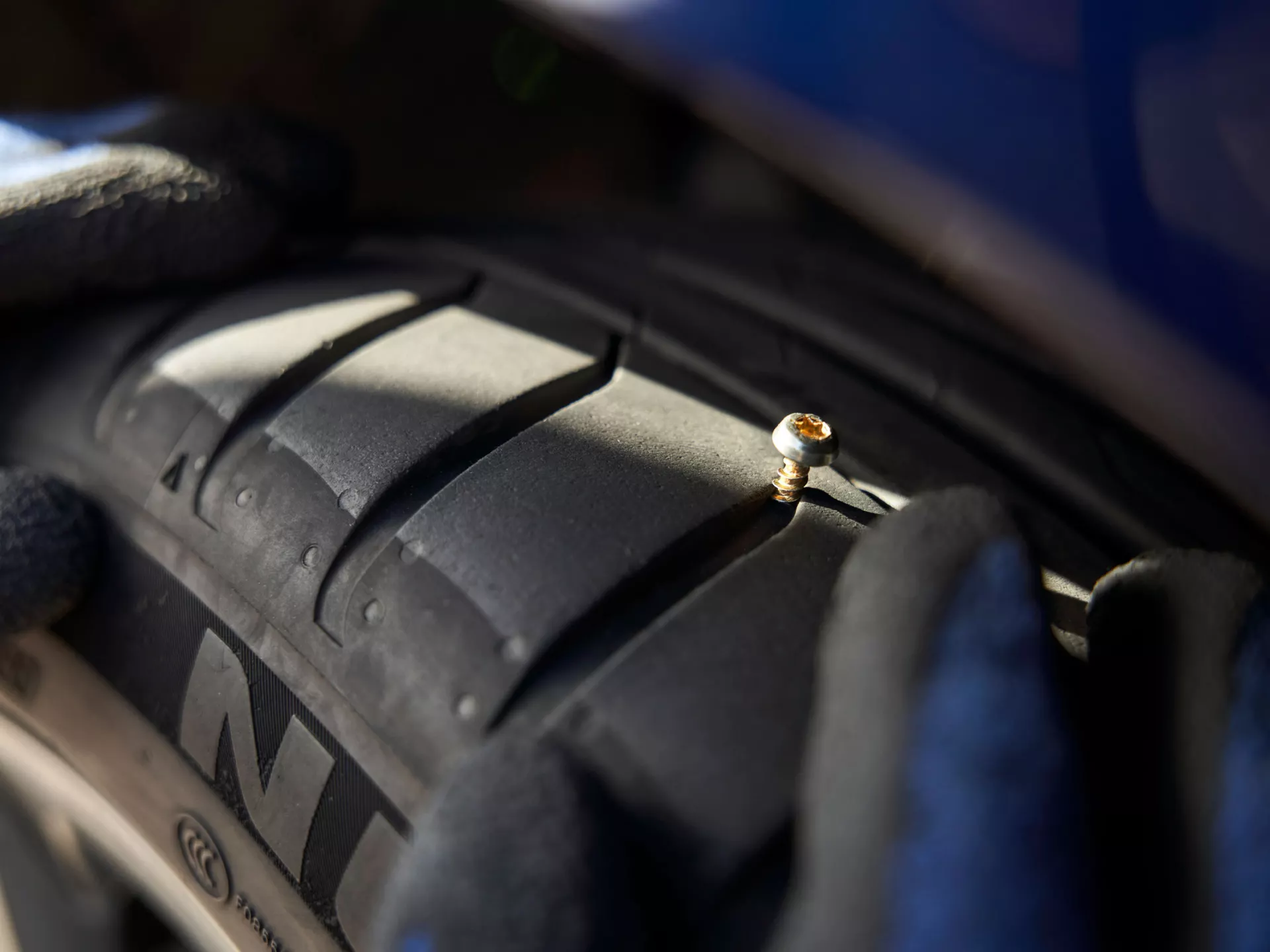
Self-sealing tyres that close small punctures on their own, so a nail or a stone doesn't leave you changing a wheel at the roadside.
Go to AirStop® TyresWheels and Tyres
Tyre fitment, Volkswagen Genuine +Tyres, rims, complete wheels and wheel accessories — and the service that fits them.
Go to Wheels and TyresWheel and Tyre Services
Not sure which tyres suit the way you drive, or want your wheels and tyres checked over? Your Autohaus Namibia team will be happy to help.